










In the first half of 2025, China bee product exports 2025 experienced a mixed performance. While the total export volume stood at 872,000 tons—a slight decline of 0.7% year-on-year—the export value dropped more sharply by 4.78%. Despite this, deeper analysis reveals some astonishing breakout markets and product categories that are reshaping the future of China’s apicultural trade.
Let’s dive into six of the most insightful trends reshaping this industry.
🐝 1. Honey Remains Dominant but Faces Competitive Headwinds
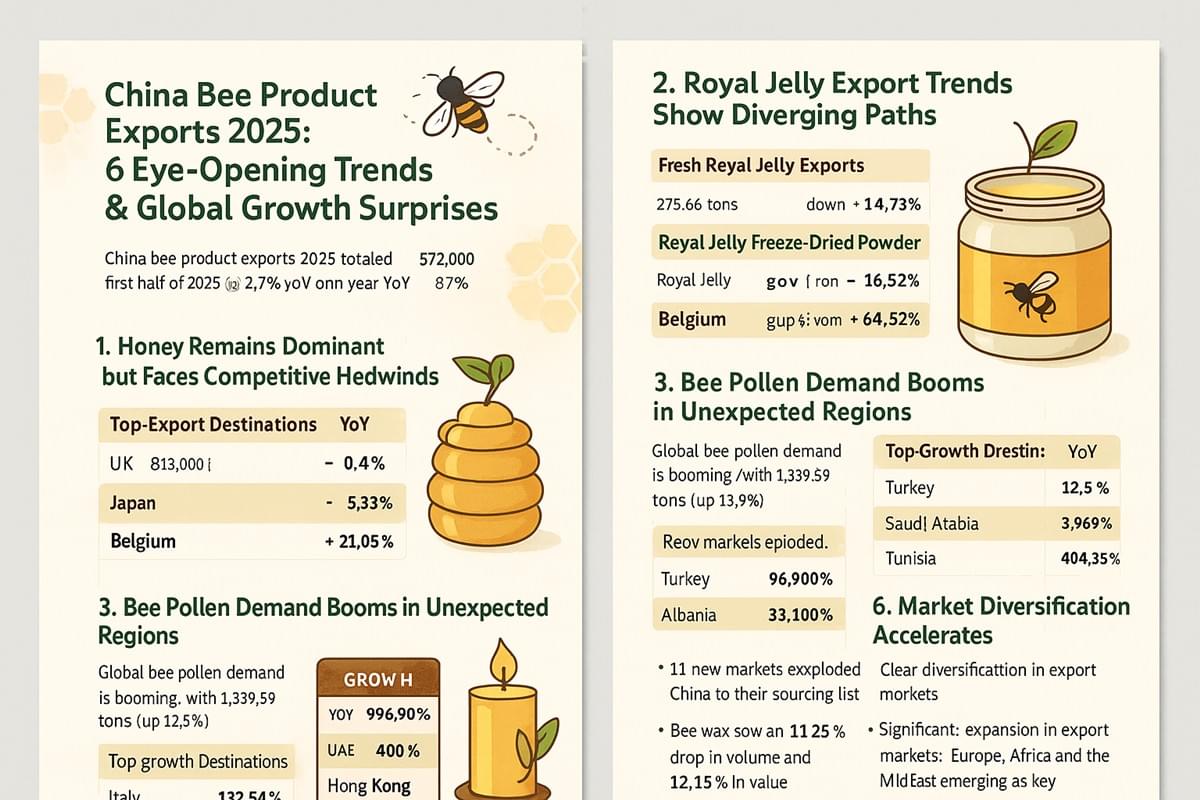
Honey continued to be the flagship of China’s bee product exports, with a total of 813,000 tons shipped, down slightly by 0.4%. The export value, however, saw a 5.44% decline, suggesting pressure from global pricing or increased competition.
Top Honey Export Destinations in 2025:
| Country | Export Volume (tons) | YoY Growth |
| UK | 21,000 | -8.88% |
| Japan | 17,600 | +5.23% |
| Belgium | 12,300 | +21.05% |
Interestingly, emerging markets stood out:
- UAE: +275% in volume, likely due to growing food industry demand.
- South Africa: +93.7% volume growth, aligning with a rising trend in natural health products.
These trends indicate that while traditional buyers such as the UK and Japan remain key, honey export statistics China 2025 point to a broadening demand footprint globally.
🧬 2. Royal Jelly Export Trends Show Diverging Paths
Fresh royal jelly exports dropped to 276.66 tons, a sharp 14.73% decrease. Value-wise, the drop was even steeper at 19.31%. Despite this, Chinese royal jelly export trends highlight a growing appetite for derivatives:
- Royal Jelly Freeze-Dried Powder grew by 16.52% in volume and 15.75% in value.
- Royal Jelly Formulations surged by 45.05% in volume and 64.52% in export value.
Top Growth Destinations for Royal Jelly Freeze-Dried Powder:
| Country | Volume Growth (%) |
| Italy | +932.92% |
| UAE | +400% |
| Hong Kong | +29,900% |
This diversification into processed forms suggests buyers are favoring convenience, shelf-stability, and usability in supplements and health products.
🌸 3. Bee Pollen Demand Booms in Unexpected Regions
The global demand for bee pollen is booming, particularly in less traditional markets. In H1 2025, China exported 1,339.59 tons, up 12.5% in volume.
Breakout Importers of Chinese Bee Pollen:
| Country | YoY Volume Growth |
| Turkey | +96,900% |
| Albania | +35,100% |
| Morocco | +862.79% |
The data shows that bee pollen international demand is rising sharply due to its reputation as a superfood and natural supplement. Even the number of importing nations rose—11 new countries added China to their sourcing list, including Argentina, Iraq, and Portugal.
🕯️ 4. Traditional Markets Shift in Bee Wax Exports
Bee wax saw a drop of 11.25% in volume and 12.15% in value, but that doesn’t tell the whole story. Although Germany and the US—the traditional top destinations—cut imports, new markets exploded:
- Bolivia: +99,900% growth
- Saudi Arabia: +3,956%
- Tunisia: +404.35%
These figures align with a global trend toward natural waxes for cosmetics and candle-making industries, and perhaps localized production spikes in emerging markets.
🧭 5. Regional Shifts: Provinces Driving Export Growth
Several Chinese provinces emerged as key players:
- Zhejiang led royal jelly and freeze-dried powder exports.
- Henan remained the largest bee pollen exporter, with over 708 tons shipped.
- Sichuan saw honey exports grow by 371.21%, showcasing its potential as a rising bee product hub.
| Province | Product Type | YoY Growth (%) |
| Sichuan | Honey | +371.21% |
| Jiangsu | Fresh Royal Jelly | +31.46% |
| Hunan | Freeze-Dried Powder | +201.19% |
These trends highlight the decentralized strength of China’s apiculture industry.
📈 6. Market Diversification Accelerates
Perhaps the most promising sign from the China bee product exports 2025 data is the clear diversification in export markets:
- Export destinations for bee wax and pollen expanded significantly.
- Europe, Africa, and the Middle East emerged as key growth zones.
- Exports are no longer reliant on a handful of nations, minimizing geopolitical and demand risks.
✅ Final Thoughts
The first half of 2025 paints a picture of resilience and transformation. While some segments like raw royal jelly and honey face headwinds, others such as freeze-dried products and bee pollen are booming. With the expansion into non-traditional markets, China’s bee product industry appears to be evolving toward value-added, diversified global engagement.
China’s beekeepers, exporters, and policymakers would do well to continue promoting advanced processing, maintaining high-quality standards, and leveraging trade opportunities with emerging health-conscious economies.
Data source: General Administration of Customs of China