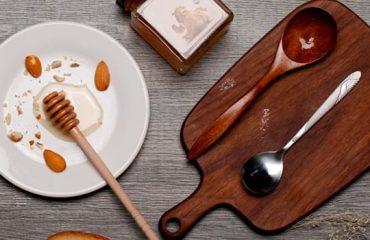







Here’s a truth every honey buyer learns eventually: the same amber liquid can leave the dock as a commodity and land on a shelf as a premium brand. What changes in between? Almost always honey packaging design. 🍯
For brands and importers positioning honey in premium retail, foodservice, or gifting channels, packaging isn’t a finishing touch — it’s the variable that decides consumer perception, shelf velocity, and brand equity. This guide covers the formats that matter, the design strategies that differentiate, and the sustainability requirements that now shape export markets. If you’re weighing private label programs alongside it, our OEM and private label pillar picks up where this leaves off.
🏆 Why Packaging Decides the Margin
Why Honey Packaging Design Outranks Price on the Shelf
Honey is a commodity-grade ingredient in bulk procurement and a premium artisan product in retail — frequently from the very same raw material. The gap between those two outcomes is almost entirely presentation.
Consumer research in the specialty food market keeps pointing the same direction: packaging quality, visual design, and label communication drive purchases in premium honey, ahead of both price and flavor claims. For importers building a branded or private label range, packaging strategy deserves the same rigor as sourcing strategy.
🫙 Primary Container Formats
Four families cover nearly every honey packaging design decision you’ll make as a brand owner.
Glass Jars: The Honey Packaging Design Benchmark
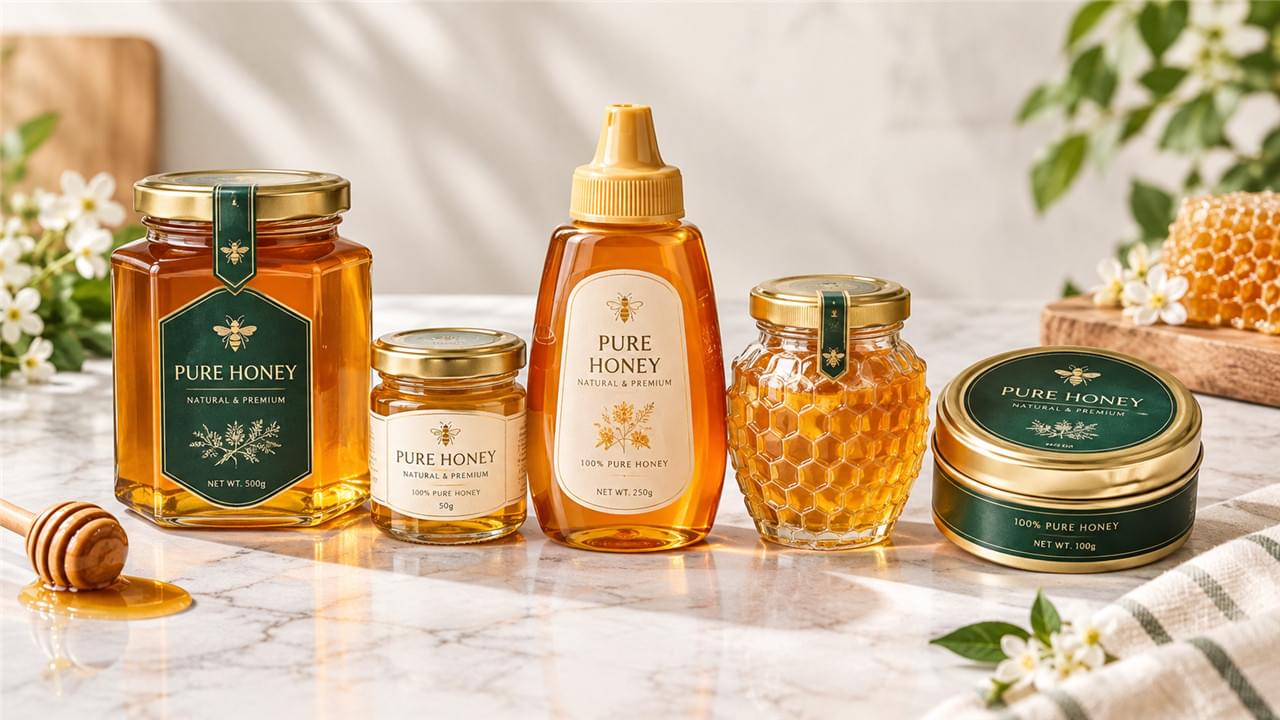
Glass remains the premium standard. Transparency lets shoppers assess color and clarity — two quality signals that sit high in the perception hierarchy — and glass is chemically inert, so flavor holds across extended shelf life with zero container interaction.
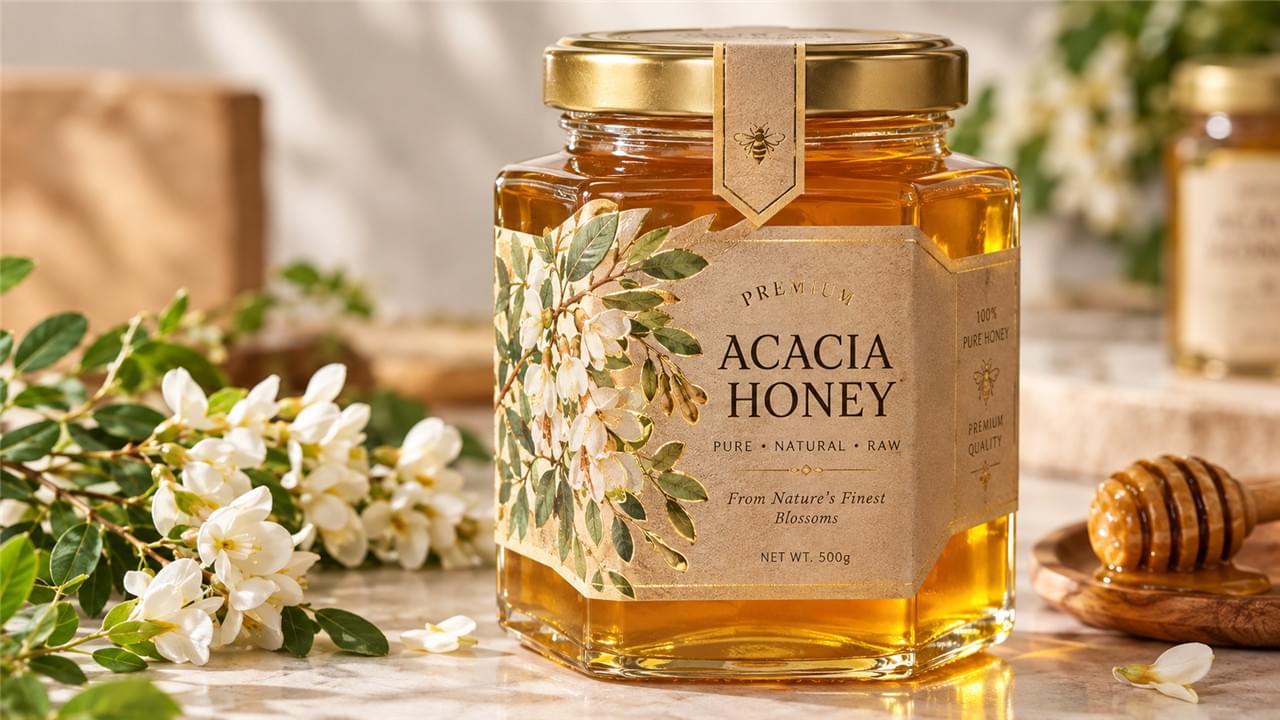
Retail sizes of 250g, 375g, 500g, and 1kg cover everything from impulse buy to household staple — the four honey jar types that do the most volume worldwide. Hexagonal jars carry strong artisan associations; cylindrical and tapered shapes buy you more label area for storytelling. For a deeper dive into matching shape to market, see our guide to choosing the right honey jar.
Small-Format Honey Packaging Design for Gifting and Foodservice
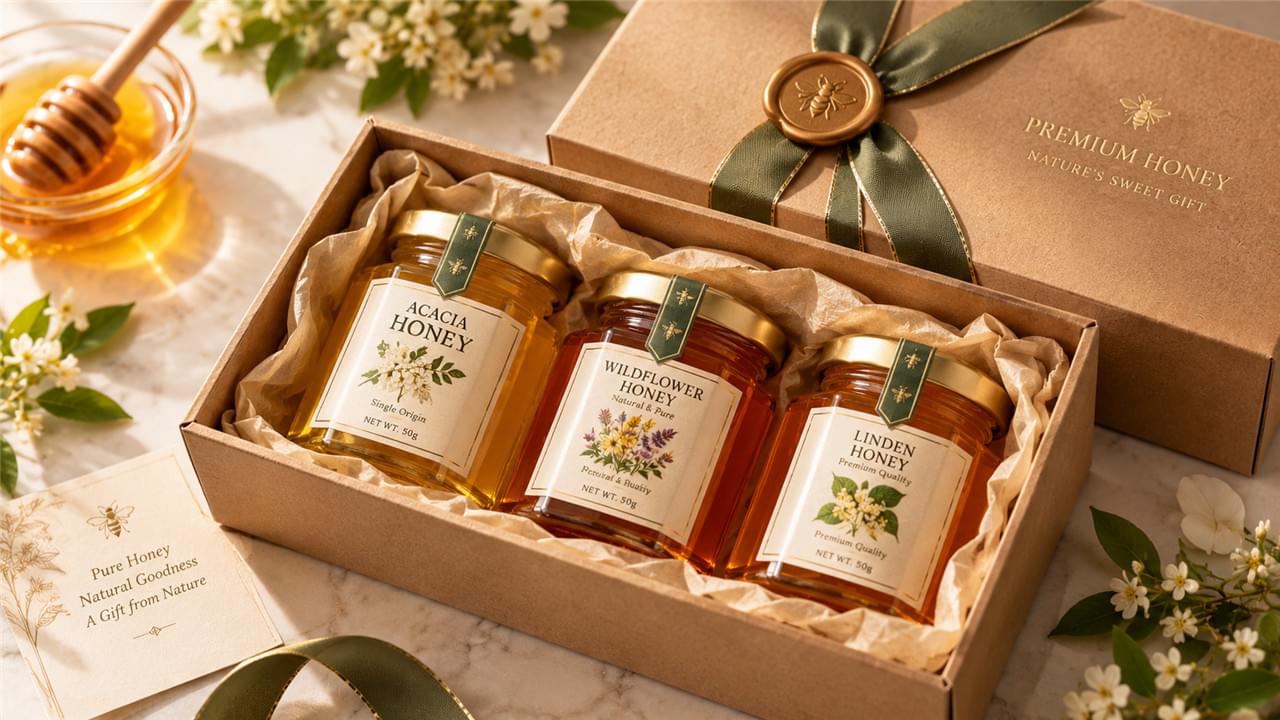
Miniature glass jars (30g, 50g) do the heavy lifting in gifting, foodservice, and e-commerce sampling. Individual creamers and sachet portions are standard across hospitality — hotels, airline catering, premium restaurant service.
Here’s the part buyers often miss: for brands building gift sets or hospitality accounts, small formats frequently deliver the highest margin in the entire range.
Squeeze Bottles and Bulk Honey Packaging Design
Squeezable HDPE or PET containers serve mass-market retail and foodservice where convenience wins. They’re standard in breakfast and condiment aisles. The trade-off is honest — less premium than glass, but unbeatable for high-frequency daily use.
Bulk moves differently. Industrial and foodservice accounts typically receive honey in 25kg metal drums (tins) for medium-volume export, 300kg steel drums for larger industrial supply, and IBC totes at 1,000 liters for high-volume manufacturing.
🎨 Design Strategy for Brand Differentiation
Honey Packaging Design Language: Botanical, Minimalist, or Origin-Led
The visual vocabulary of honey branding has shifted. “Cute bees and golden hexagons” still works for some segments, but premium and specialty brands have moved toward more sophisticated territory:
- Botanical illustration — detailed depictions of the nectar plant behind each varietal (acacia flowers, linden blossoms, buckwheat) communicate floral origin with genuine elegance.
- Minimalist premium — clean typography, restrained palettes, and premium paper labels with embossing or foil. This approach suits monofloral varietals at higher price points.
- Origin and provenance storytelling — naming a region, country, or even a specific apiary satisfies growing appetite for transparency. “From the linden forests of Northeast China” carries far more weight than a generic “pure honey.”
Building a private label range? Delee Honey supports full custom honey label design — from brand consultation through compliance review for your target market. Browse the packaging formats to start.
♻️ Sustainable Honey Packaging Design Trends
Sustainability has moved from niche value to mainstream procurement requirement, and it now shapes honey packaging design as much as aesthetics do — especially across the EU, UK, and North America:
- Recyclable glass: Already standard for premium honey, with strong recyclability credentials and consumer recognition.
- Reduced plastic: Aluminum closures replacing plastic caps, paper-based outer packaging, shrink film eliminated.
- Recycled content labels: FSC-certified paper and soy-based inks, increasingly specified by retailers with sustainability commitments.
- Refillable formats: A growing specialty niche — larger refills that cut packaging per unit of honey.
For export-focused buyers, keep documentation ready: EU packaging rules and retailer sustainability charters both feed into regulatory expectations you may need to evidence.
📋 Packaging Procurement Checklist
Sourcing honey for retail or gifting? Run this list before you commit:
- Container format and capacity (retail, foodservice, or bulk)
- Label dimensions and print spec — window or no window
- Closure type: metal cap, swing-top, or corked
- Material certification: food-grade, BPA-free where applicable
- Minimum order quantity for custom-labeled product
- Lead time for packaging procurement versus honey supply
Delee Honey handles the full arc — bulk supply through retail-ready product — with custom label options for private label programs. Tell our export team what you’re building via our contact page and we’ll map the packaging to your market. 🐝