

Ask experienced importers what actually matters in honey sourcing and the answer surprises newcomers: reliability beats price, every time. A supplier offering attractive rates but inconsistent paperwork, lot-to-lot quality swings, or shaky delivery timing creates operational costs that swallow the savings whole. That’s why honey supply chain logistics deserves the same scrutiny as the price per kilo — arguably more. 🍯
This guide walks through the five elements that separate a well-run supply chain from a risky one: how bulk procurement is structured, what documents you should expect, how honey travels and stores correctly, what to verify when a shipment lands, and how to build supplier relationships that reduce risk year over year.
🛒 Bulk Procurement: The Honey Supply Chain Logistics Starting Point
Tiered Pricing and Trial Orders in Honey Supply Chain Logistics
Bulk honey import from China typically runs on a tiered volume structure. Pricing steps down at standard thresholds — commonly 1MT, 5MT, 10MT, and container-load quantities (roughly 20–22MT per 20-foot FCL). New buyers usually start with a 1–2MT trial order to verify quality against spec before committing to volume, and reputable suppliers will accommodate that without complaint.
Incoterms in plain terms: FOB is the most common export term for Chinese honey — you arrange freight and insurance from the Chinese port. CIF includes the seller arranging freight and insurance to your destination port, which is often easier to manage for new import relationships. EXW places everything on the buyer.
Specification Confirmation in Honey Supply Chain Logistics
Before production begins, lock a detailed written specification with your supplier:
- Honey variety and floral source
- Color grade (Pfund or USDA scale)
- Moisture content (typically ≤20% per Codex)
- HMF content (typically ≤40mg/kg per Codex)
- Diastase activity (typically ≥8 Schade units)
- Microbiological standards, pesticide residue limits, and heavy metal maximums (lead, cadmium, mercury, arsenic)
- Packaging format, container specification, and labeling requirements
A well-documented spec protects both sides — and it’s the reference point if a quality dispute ever surfaces.
📑 Export Documentation: What the Honey Wholesale Supplier Must Provide
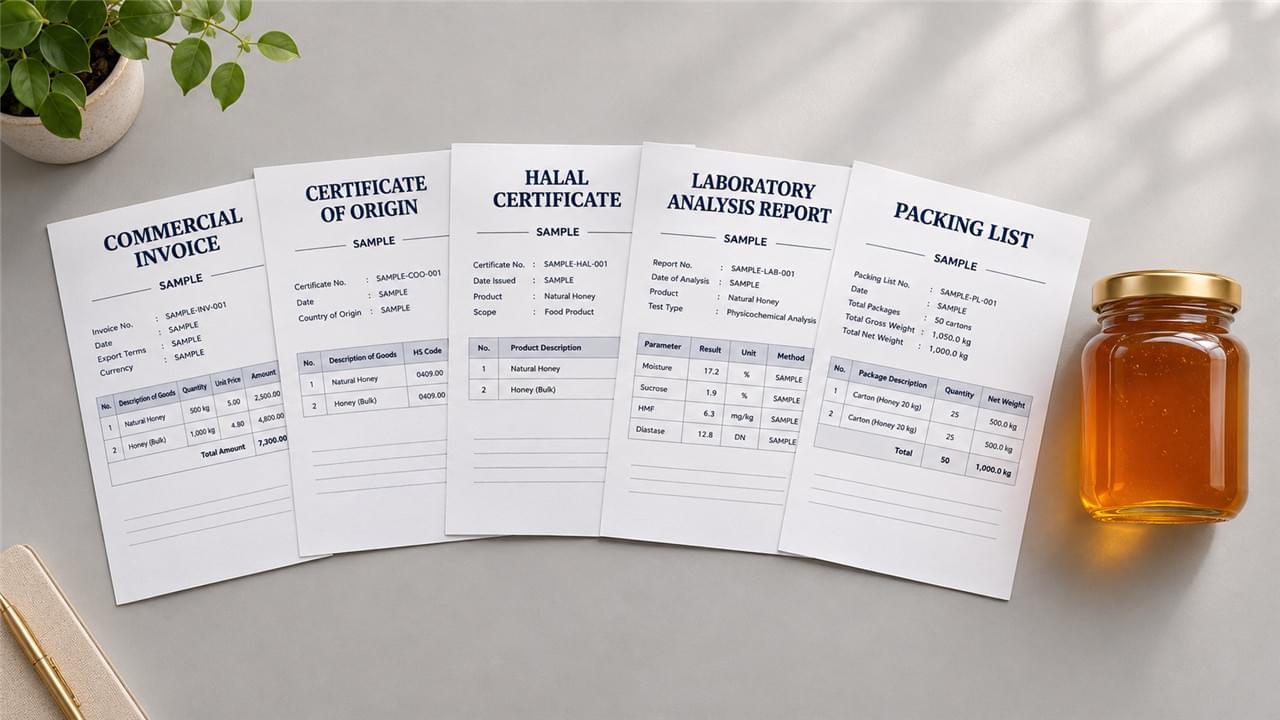
International honey shipments require a standard document package, with exact requirements varying by destination market:
- Commercial invoice — goods, quantities, unit price, total value, payment terms
- Packing list — packaging configuration, gross/net weights, container numbers
- Certificate of origin — confirming Chinese origin, issued by CCPIT or the local Chamber of Commerce
- Health certificate — issued by China’s GACC confirming export health compliance
- Third-party lab analysis — pesticide residues, heavy metals, HMF, moisture, microbiology, from an accredited laboratory
- HALAL certificate — mandatory for Middle East and Muslim-majority markets, issued by a body recognized in the importing country
- Phytosanitary certificate — required by some import markets
Delee Honey prepares complete export documentation packages as standard for every international shipment, with additional documents available for specific market rules. Quality certification requirements run deep in this industry — our P2 pillar on quality certification and sustainable supply covers the standards landscape in detail.
🚢 Transportation and Storage: Protecting Quality in Transit
Honey is stable, but it still punishes careless handling.
Temperature Control in Honey Supply Chain Logistics
Extended storage above 25°C accelerates HMF formation and degrades enzyme activity — the two markers that define fresh, quality honey. Cold storage isn’t required (and is actually counterproductive: cold promotes crystallization in many varieties). A cool, stable environment of 15–20°C is the sweet spot. 🌡️
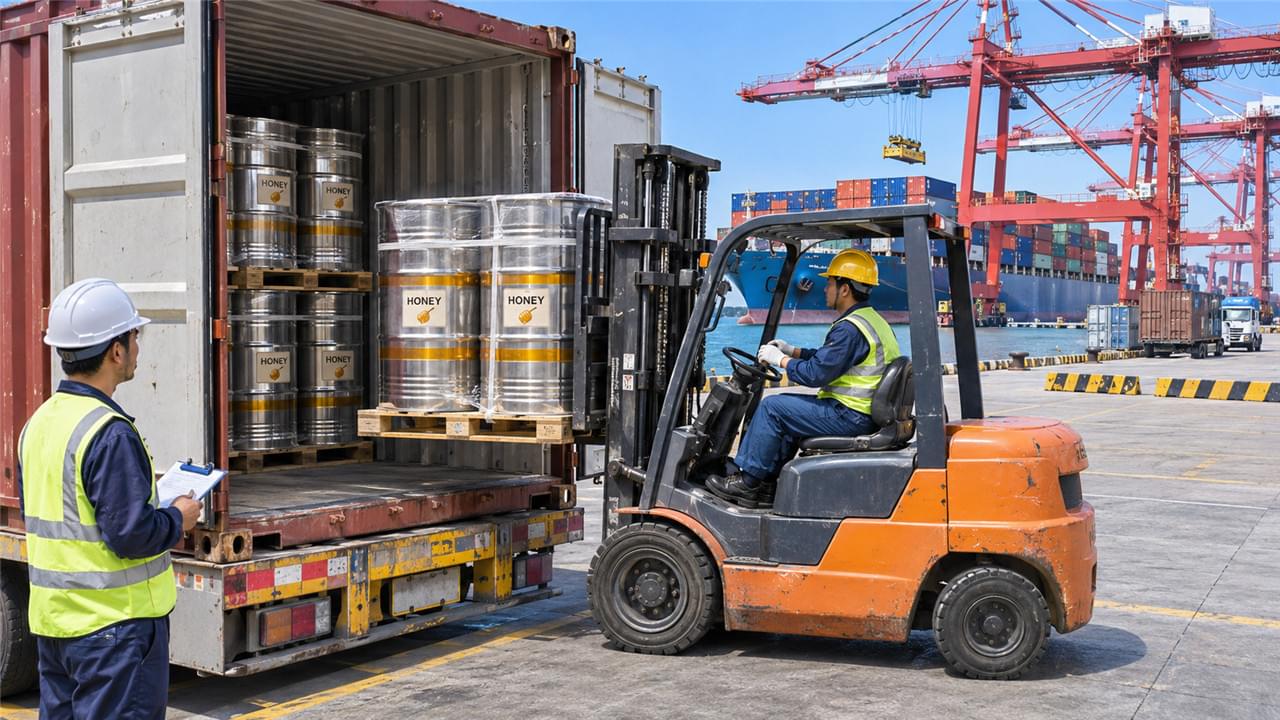
Container shipment: Standard FCL sea freight is the norm for honey export logistics. Containers shouldn’t be loaded in direct sun or stowed next to high-heat cargo. Summer transit through hot regions — Middle East sea routes especially — can push container temperatures above 30°C. Flag it to your logistics partner before sailing, not after arrival.
Bulk Packaging in Honey Supply Chain Logistics
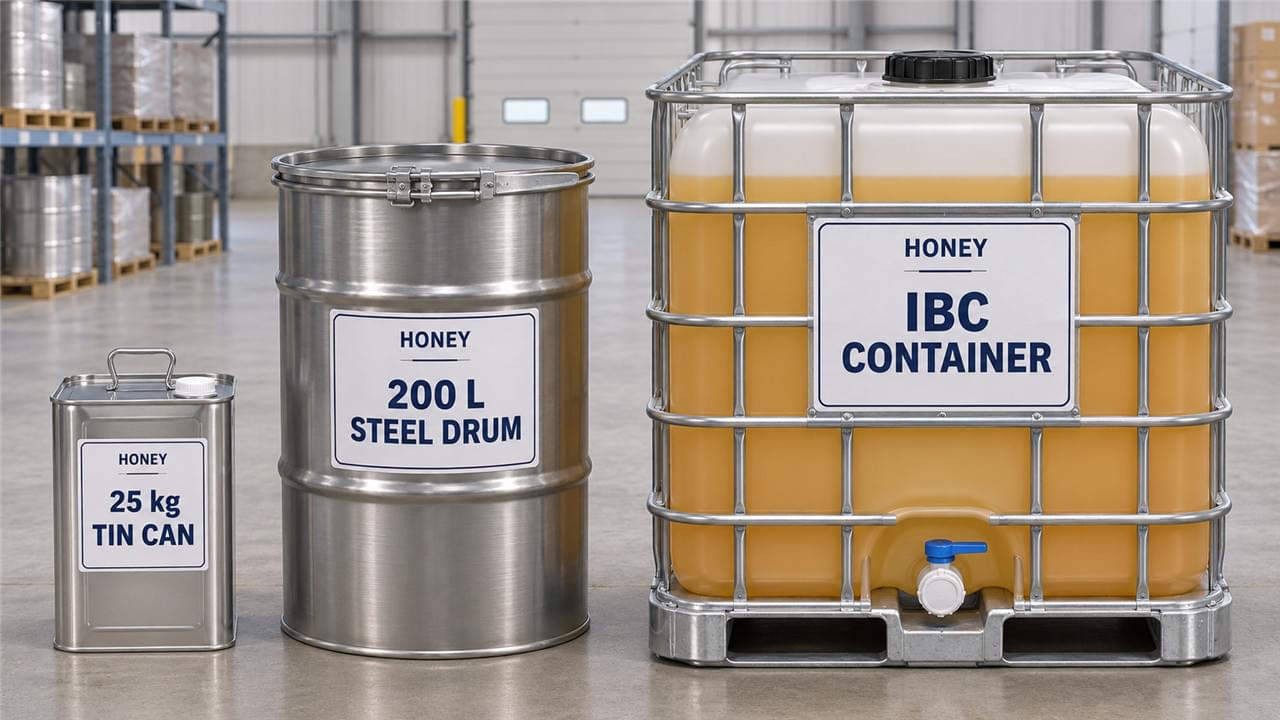
| Format | Best For | Notes |
|---|---|---|
| 25kg metal tins | Small-volume orders | Stackable, food-grade lining; economical below 5MT |
| 200–300L steel drums | Medium-volume export | Food-grade plastic liner; ~240kg honey per drum |
| IBC tanks (1,000L) | Large-volume industrial supply | ~1,350–1,400kg per tank; needs forklift unloading |
Choosing between formats early avoids repacking costs later — details on bulk options show how each format ships in practice.
✅ Quality Assurance at Receipt
Build a receive-and-verify protocol for every incoming shipment:
- Document verification — all required documents present and matching the shipment
- Container/seal inspection — seals intact; discrepancies documented immediately
- Sampling at receipt — retain reference samples from each lot; test against spec
- Sensory evaluation — color and clarity visually, aroma for off-notes
- Laboratory confirmation — for high-value or new-supplier lots, commission independent verification
Five checks keep honey supply chain logistics honest, shipment after shipment. The discipline costs little; skipping it costs plenty.
🤝 Building a Long-Term Honey Supply Chain Logistics Partnership
The most commercially valuable supply chains are built on multi-year relationships, not transaction-by-transaction price shopping. Long-term agreements with committed volume deliver:
- Price stability — multi-year pricing hedges seasonal honey price volatility
- Supply priority — committed buyers get allocation first during tight supply periods
- Quality consistency — suppliers invest more in committed long-term customers
- Operational efficiency — established documentation, logistics channels, and communication protocols cut per-shipment admin overhead
Delee Honey operates its own supply base across 200+ bee farms — see how our supply chain works from hive to export — and supports both spot procurement and multi-year partnership models with importers and distributors across Europe, the Middle East, and Asia.
Ready to stress-test your current sourcing setup, or start a new honey supply chain logistics program? Reach out through our contact page — our export team will walk through your requirements and respond with a concrete plan. 🐝


