







🌍 What do slowing prices, fast-growing niches, and unexpected markets really tell us?
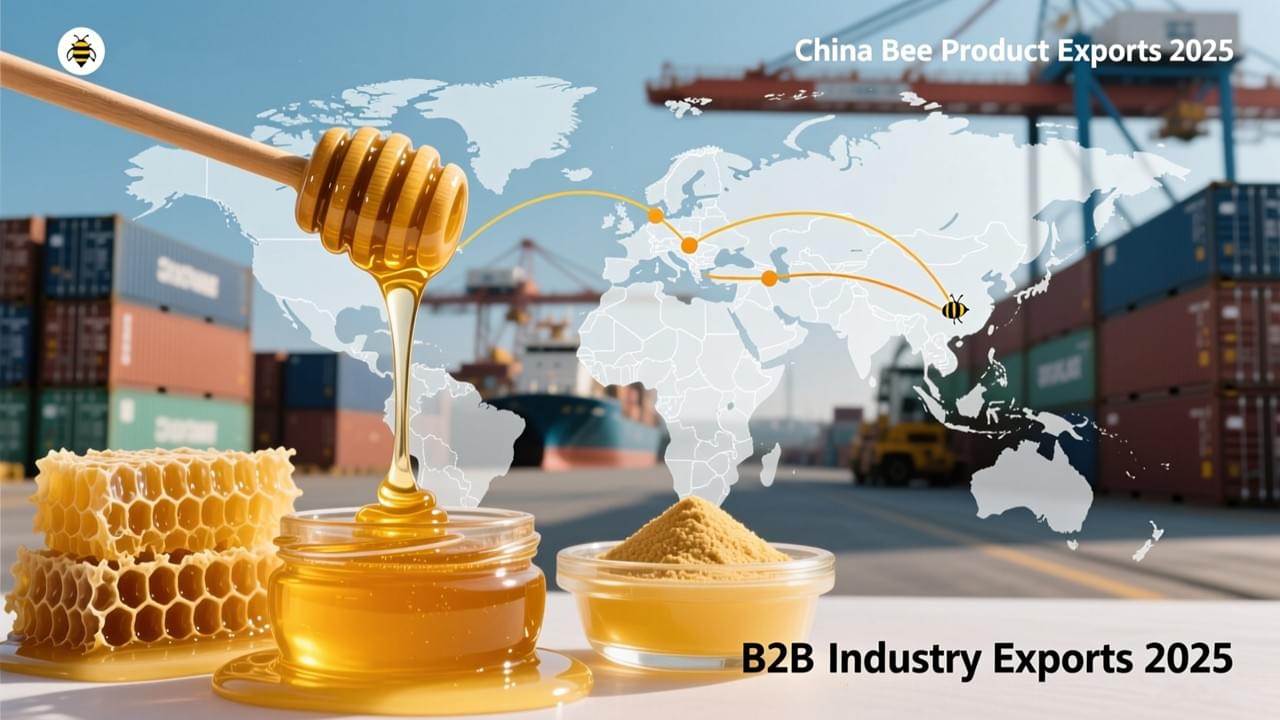
In 2025, China bee product exports entered a new phase—one defined less by volume expansion and more by structural transformation, product differentiation, and regional rebalancing.
According to official data released by China Customs, total bee product exports reached 187,700 tons, up 2.26% year-on-year, while export value declined 3.77%. This divergence sets the tone for understanding the deeper forces shaping the industry. 🐝
📦 China Bee Product Exports: Volume Growth vs. Value Pressure
At the macro level, China bee product exports continued to grow steadily in volume, driven mainly by natural honey, which accounted for over 93% of total exports. However, value contraction across several categories highlights increasing price sensitivity in global markets.
Products with stronger processing depth—such as royal jelly preparations and freeze-dried royal jelly—stood out with double-digit value growth. This contrast signals a clear market preference shift toward functional, standardized, and high-value bee products rather than bulk commodities.
🍯 China Bee Product Exports and the Honey Market Split
Within China bee product exports, honey remains the cornerstone. In 2025, honey exports reached 175,500 tons, up 3.5%, while export value fell 1.98%, reinforcing the “volume up, price down” pattern.
The China honey export market 2025 shows visible regional divergence. Traditional markets such as the UK saw declining imports, while Japan maintained stable demand with minimal price erosion. Meanwhile, smaller markets—including Slovakia, the Philippines, and Bangladesh—recorded explosive growth, reflecting rising health awareness and improved trade access.
For a global overview of honey trade dynamics, FAO data provides useful context: https://www.fao.org/home/en 🌐
🧬 Fresh Royal Jelly: Europe’s Rising Role in China Bee Product Exports
Fresh royal jelly exports revealed one of the most striking structural shifts within China bee product exports. While Japan’s imports declined sharply, Spain and France posted strong growth, reshaping the European demand landscape.
This shift aligns with broader royal jelly export trends, where European consumers increasingly favor fresh, traceable, and premium-grade products. On the supply side, Zhejiang Province continued to dominate, contributing over 76% of national exports, underscoring the importance of regional specialization.
❄️ Freeze-Dried Royal Jelly: Stable Core, Fast-Growing Frontiers
Among all categories, freeze-dried royal jelly emerged as a strategic bright spot in China bee product exports. Japan, Spain, and the United States remained core markets, offering stable baseline demand.
What’s more compelling is the surge from Italy, the UAE, and Saudi Arabia—clear evidence of accelerating emerging markets for bee products. These regions value shelf stability, functional claims, and premium positioning, all strengths of freeze-dried formats.
This mirrors broader global health ingredient trends tracked by the WTO: https://www.wto.org 📈
🌼 Bee Pollen: Niche Markets Reshaping China Bee Product Exports
Bee pollen exports illustrated how niche markets can quickly rewrite rankings. While Korea and the US reduced imports, Belgium and Poland surged into the top tier, driven by demand for plant-based nutrition and sports supplements.
From a provincial perspective, Henan remained the backbone supplier, but Guangdong and Qinghai showed explosive growth, highlighting how agile regional players can capture emerging demand within China bee product exports.
🕯 Beeswax: New Markets Cushion Structural Decline
Beeswax exports declined overall, yet China bee product exports demonstrated resilience through diversification. New destinations such as Mexico, Tunisia, and Georgia offset shrinking demand from Germany and the US.
This expansion into non-traditional markets confirms that adaptability—not scale alone—is becoming the defining success factor in beeswax trade.
🚀 What China Bee Product Exports Signal for 2026
Taken together, China bee product exports in 2025 tell a clear story:
📌 Bulk products face long-term price pressure
📌 Processed and functional products deliver higher resilience
📌 Emerging markets are no longer peripheral—they’re strategic
For exporters, success in 2026 will depend on product upgrading, market diversification, and compliance-driven branding, not just output growth.
📊 Source: General Administration of Customs of China
https://www.customs.gov.cn
🌟 Why Global Buyers Choose Delee Honey
As global demand shifts toward higher standards, traceability, and value-added bee products, Delee Honey stands out as a trusted partner within the evolving landscape of China bee product exports. Backed by stable raw material sourcing, advanced processing capabilities, and strict quality control aligned with international regulations, Delee Honey supplies a full range of honey and bee products tailored for global B2B markets.
With proven export experience across Europe, the Middle East, and Asia, Delee Honey supports importers, brand owners, and food manufacturers seeking consistent quality, regulatory compliance, and long-term supply reliability. As 2025 highlights a clear transition from volume-driven trade to value-oriented growth, Delee Honey is well positioned to help global partners capture opportunities in the next phase of the bee product industry.
🔗 Learn more at: https://deleehoney.com


