

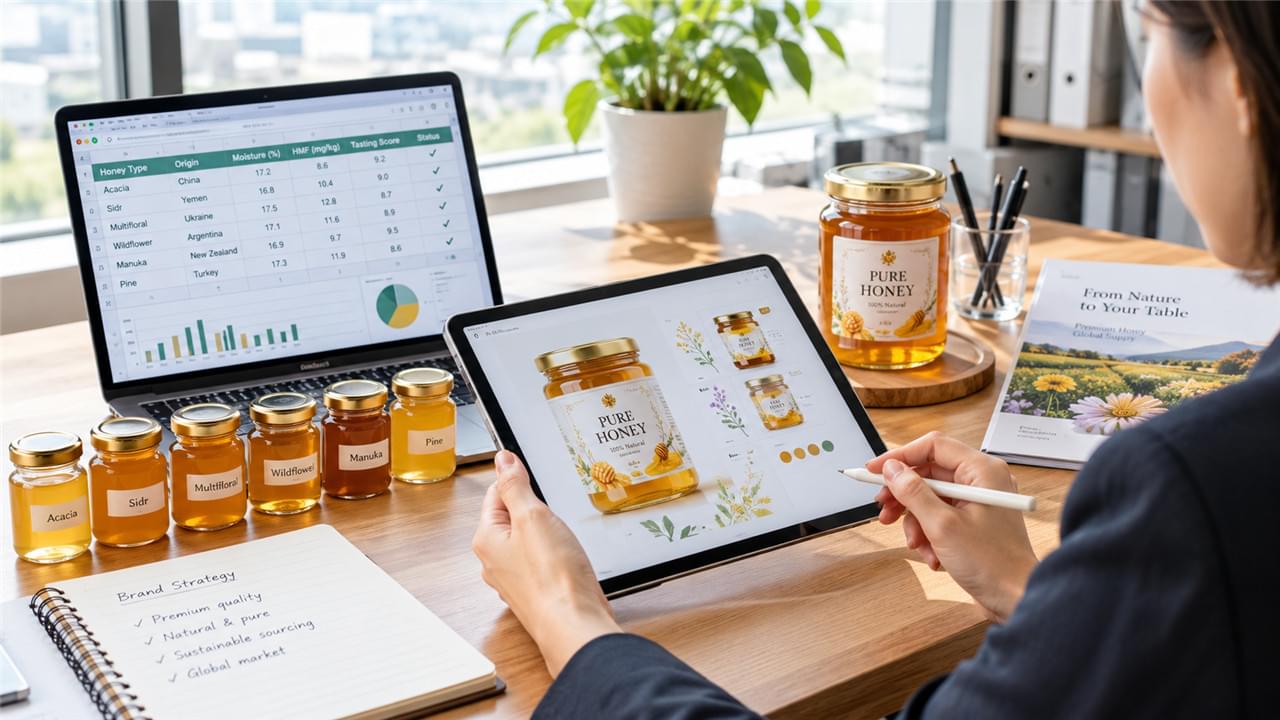
If you’ve been researching how to start a honey brand, you’ve probably noticed what every newcomer eventually does: the barriers are lower than they look. Honey enjoys universal consumer appeal and clean-label status, and established Chinese manufacturers offer quality sourcing at scale. That makes a private label honey brand one of the more accessible entries into premium food — provided you work each stage with genuine diligence. 🐝
This guide walks the five stages of private label honey development in the order they typically happen, with the practical considerations that matter at each one. For the supplier-side view — what an OEM partner actually handles — our honey OEM and private label pillar pairs well with this one.
Private Label Honey Development: The 5-Stage Roadmap
Stage 1: Define the Private Label Honey Concept 🎯
Before approaching any supplier, nail down four parameters:
Target market: Who buys this honey, and through what channel? A premium grocery buyer in Germany has different requirements than a mass-market retailer in Southeast Asia. Your answer drives variety, grade, packaging format, and label language.
Honey variety: Acacia suits premium, mild-flavored positioning; wildflower is more cost-effective for broad appeal; specialty varieties (linden, jujube, longan) differentiate in saturated markets. Monofloral options support premium pricing and origin storytelling.
Price point: Target retail price determines acceptable COGS, which in turn constrains honey grade, packaging format, and production volumes.
Volume estimate: Private label MOQs typically start from 500kg for retail-packed product. A clear estimate — even a range — helps suppliers quote accurately and prioritize your inquiry.
Stage 2: Qualify Suppliers — Private Label Honey Sourcing Is Won Here 🔍
Supplier qualification for food products takes more than a price comparison. The checklist:
Quality certifications: ISO 22000, HACCP, and HALAL are baseline requirements for most export markets — and ISO 22000 food safety management is the framework large retailers audit against. EU market access may require additional documentation.
Traceability: Can the supplier provide batch-level traceability from apiary to shipment? Retailers increasingly require it, and any origin-story positioning stands on it.
Laboratory analysis: Insist on third-party testing reports (pesticide residues, heavy metals, HMF, moisture content) for every production batch, not just the sample.
Sampling: Evaluate honey against your specification for color, flavor, aroma, moisture, and crystallization behavior before any commercial commitment.
Export track record: A supplier with documented export history to your target market has already navigated the compliance maze. That reduces your risk more than any discount will.
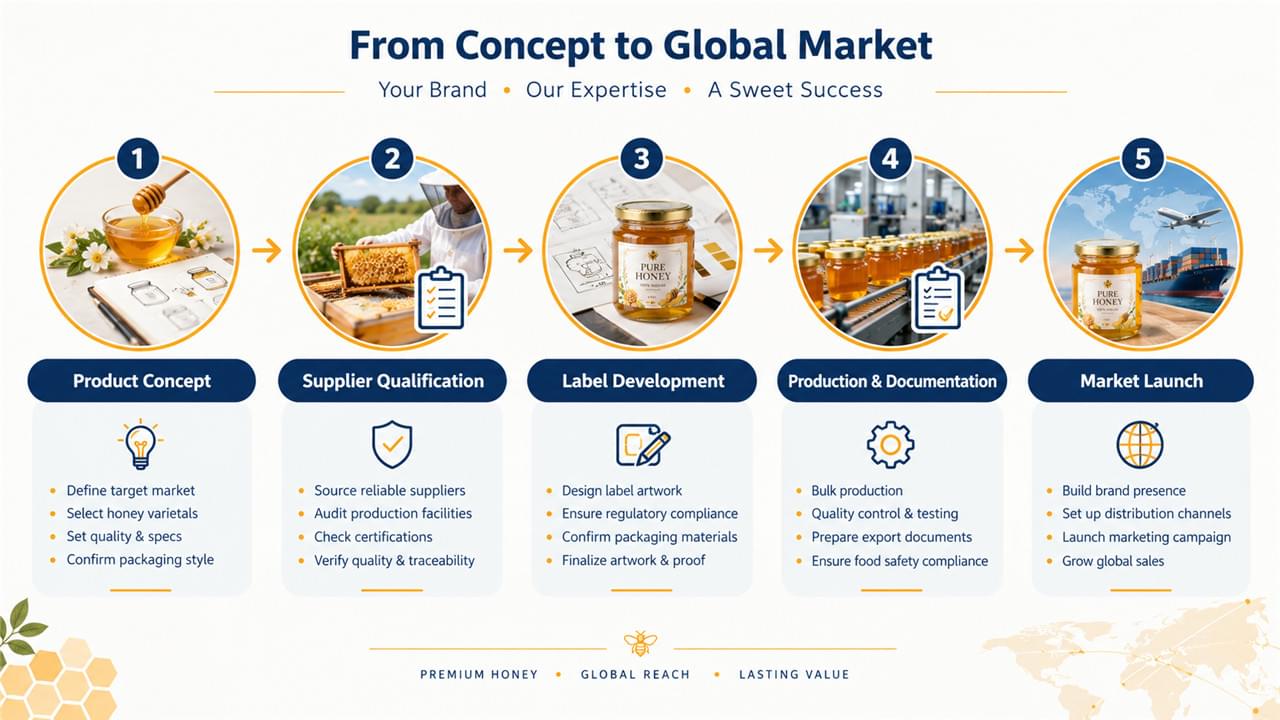
Stage 3: Label Rules Every Private Label Honey Jar Must Follow 🏷️
Label development has two dimensions — creative and regulatory — and both matter:
Mandatory information (EU example): product name, net weight, country of origin, best-before date and storage instructions, packer/importer name and address, nutritional declaration, and allergen notes. Honey itself isn’t a major allergen, but cross-contamination statements may apply for products packed in multi-allergen facilities.
Design: Invest in professional design. As our honey packaging design pillar covers in depth, label material quality and design quality are the primary purchase drivers in premium honey retail.
Regulatory review: Have every label checked against target-market food labeling regulations before finalization. Non-negotiable in the EU, where the rules are detailed and actively enforced.
Stage 4: Lock Production and Documentation ⚙️
Once the product specification and label design are finalized:
- Confirm production timeline and lead time
- Agree on quality control hold-point procedures (inspection before shipment)
- Arrange third-party pre-shipment inspection if required
- Confirm export documentation: certificate of origin, health certificate, laboratory reports
- Settle Incoterms and logistics arrangements
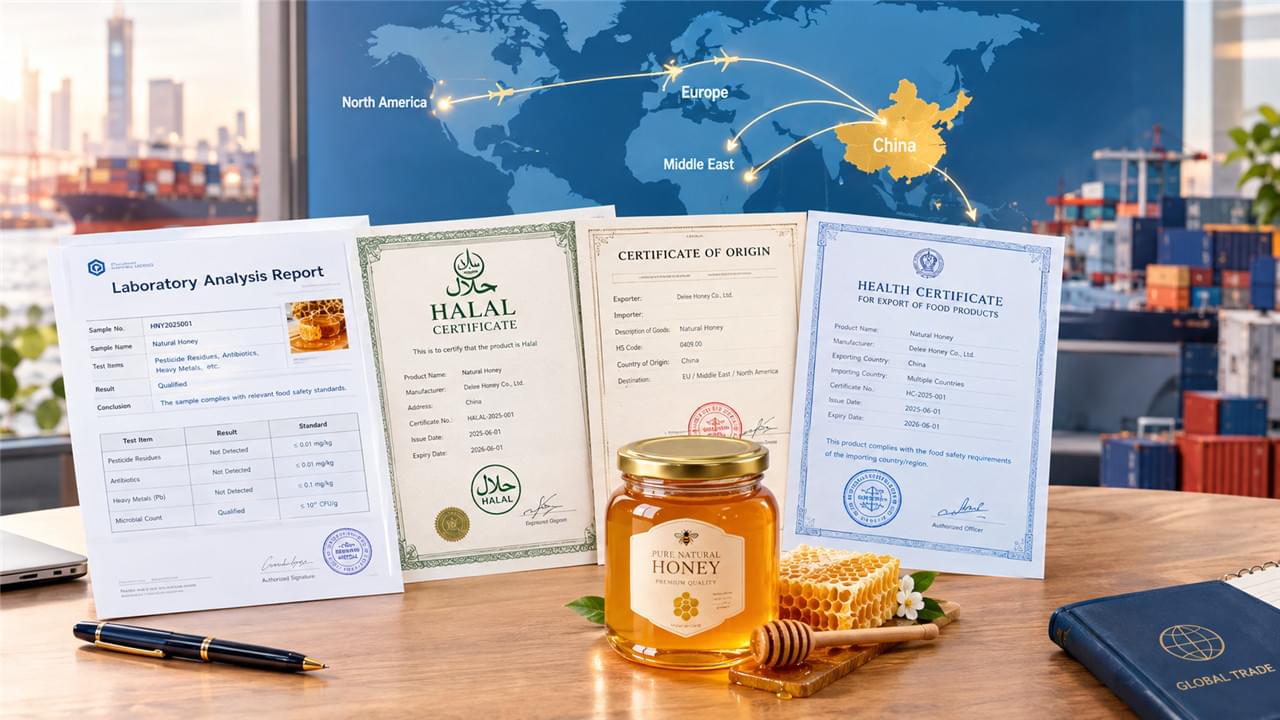
Stage 5: Private Label Honey Launch and Market Entry 🚀
Customs clearance: Have all import documentation in order before the goods arrive. An experienced customs broker in your market saves real time and money.
Regulatory registration: Some markets require product registration before sale — check early, not at the dock.
Channel launch: Private label honey only earns money once it’s visible, so coordinate availability with your sales channel: retail buyer presentations, online store setup, distributor onboarding.
Starting Your Private Label Honey Program with Delee 🤝
Delee supports private label programs from initial concept through commercial launch — complimentary samples, label consultation, full export documentation, and competitive pricing for both retail-packed and bulk honey. Whether you’re building a honey white label business from scratch or extending an existing range, the process is the same. Curious what the cooperation looks like from the supplier side? Our companion guide on OEM cooperation advantages breaks it down.
To begin the conversation about your program, reach the export team via deleehoney.com/about-us/. 🐝