








Importing honey from China follows a defined sequence — food safety inspection, customs declaration, documentation, logistics execution. The China honey export process rewards buyers who understand it in advance: fewer surprises, faster timelines, and realistic expectations around lead times and compliance. 🍯
Here’s the full journey, stage by stage, drawn from Delee’s experience shipping to Europe, the Middle East, and Asia.
📝 Stage 1: Order Confirmation and Specification Agreement
The export process begins before production. Once quantity, variety, specification, packaging, and pricing are agreed, a formal purchase order or sales contract documents the transaction — and governs everything downstream.
Written Confirmation in the China Honey Export Process
Lock these elements in writing before production starts:
- Honey variety, grade, and quality specification
- Packaging format and container specification
- Unit price, total value, and currency
- Incoterms (FOB Qingdao/Shanghai/Guangzhou, or CIF destination port)
- Payment terms (T/T in advance, Letter of Credit, or agreed milestone terms)
- Shipment lead time and delivery timeline
The volume and pricing logic behind these terms sits in our honey wholesale buying guide — worth reading before you negotiate.
🏭 Stage 2: Production and In-Process Quality Control
After order confirmation, production is scheduled under Delee’s quality management system: incoming honey inspection against specification at receipt from apiaries, in-process moisture monitoring through filtration and processing, HMF and sensory evaluation before filling, and microbiological sampling from finished packed goods.
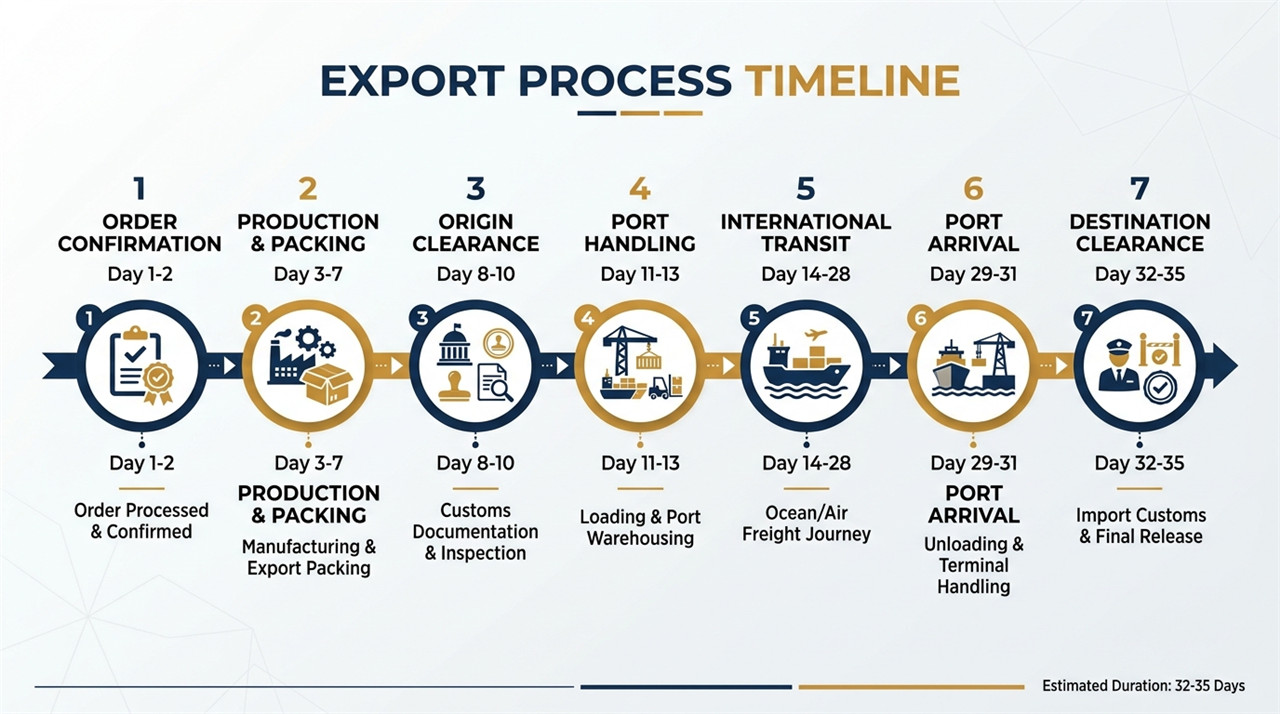
🔬 Stage 3: Pre-Export Inspection and Laboratory Testing
All honey exported from China requires official inspection through the General Administration of Customs (GACC), which holds jurisdiction over food export health certificates.
Laboratory Testing: The Critical Gate in the China Honey Export Process
Third-party laboratory analysis runs on every export lot, covering:
- Pesticide residues (EU MRL, Codex standards, or destination market requirements)
- Heavy metals (lead, cadmium, mercury, arsenic)
- HMF and moisture content
- Microbiological parameters (total plate count, yeast and mold, Salmonella)
- Antibiotic residues (sulfonamides, tetracyclines, chloramphenicol)
Laboratory turnaround typically runs 10–15 working days — the single biggest factor in your total lead time from order to shipment.
📑 Stage 4: Documentation Preparation
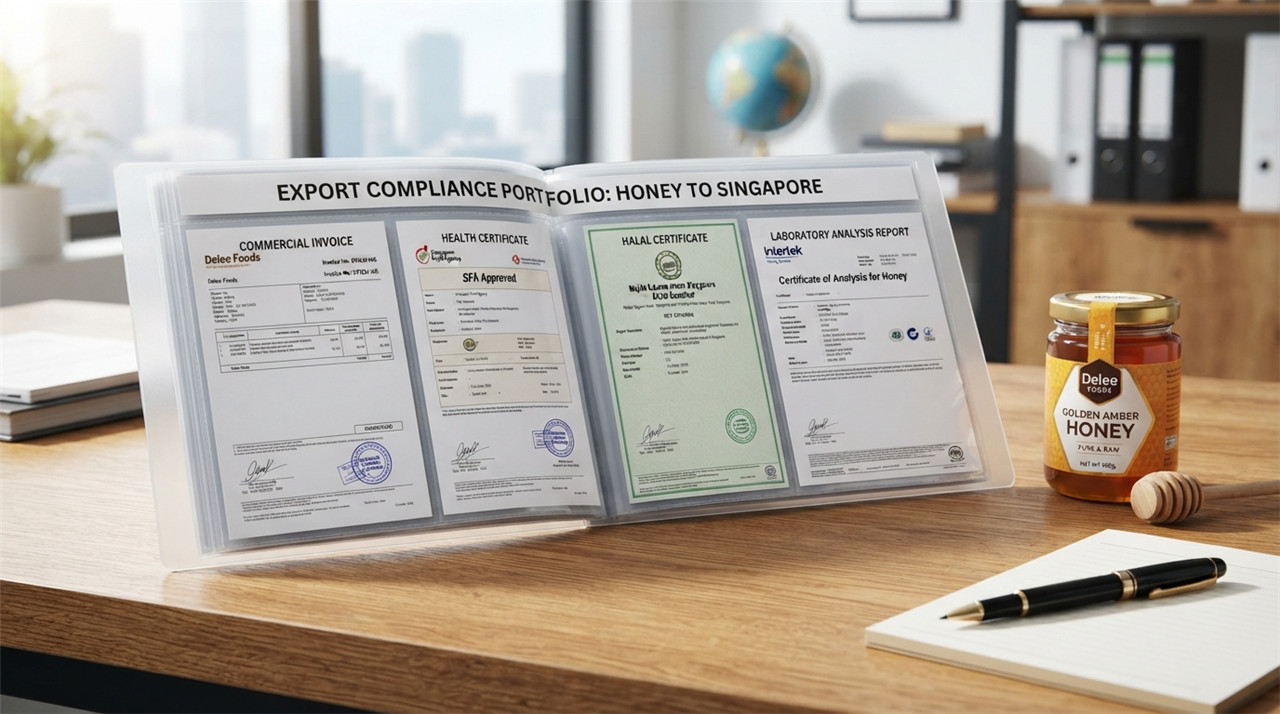
Once laboratory results confirm the spec, the full document package is compiled — the paperwork backbone of the China honey export process:
| Document | Issuing Body |
|---|---|
| Commercial Invoice | Seller (Delee Honey) |
| Packing List | Seller (Delee Honey) |
| Certificate of Origin | CCPIT or Chamber of Commerce |
| Health Certificate | GACC |
| HALAL Certificate (if required) | HALAL Certification Body |
| Laboratory Analysis Report | Accredited Third-Party Laboratory |
| Bill of Lading / Airway Bill | Freight Carrier |
Honey export documentation requirements vary by destination — EU entry paperwork, country-specific import licenses, and other additions. Your import customs broker should advise on destination-specific rules; our P2 pillar on quality certification covers the certification landscape behind these documents.
🛃 Stage 5: Customs Clearance and Loading
This is the domestic half of the China honey export process, managed by a licensed customs agent. Once the export declaration is approved, goods release for loading:
FCL (Full Container Load): the container is trucked to Delee’s warehouse, loaded, sealed with an official seal, and proceeds to port for vessel booking.
LCL (Less than Container Load): goods deliver to the forwarder’s consolidation warehouse and combine with other cargo in a shared container — more flexible for smaller volumes, at the cost of added transit time.
🚢 Stage 6: Freight and Transit
Standard sea freight transit times from major Chinese ports:
| Route | Transit Time (Approximate) |
|---|---|
| China to Rotterdam/Hamburg | 30–35 days |
| China to Dubai/Abu Dhabi | 18–22 days |
| China to Singapore | 10–14 days |
| China to Los Angeles | 16–20 days |
| China to Sydney | 18–25 days |
Air freight is available for time-sensitive or small-volume shipments at a significantly higher per-kg cost.
🏁 Stage 7: Destination Customs Clearance
On arrival, your local customs broker manages import clearance using the document package Delee provided. For EU importers, note that honey from China is subject to import controls under EU regulation — official pesticide residue sampling at EU border posts is part of the standard regime, so build the Chinese honey import procedure into your planning rather than discovering it at the pier.
The Last Mile of the China Honey Export Process
Destination clearance is where export documentation and import requirements meet. If your broker flags a gap, resolve it before vessel departure, not after arrival — that’s the cheapest honey customs clearance advice you’ll ever get.
🤝 Delee’s Export Experience
Delee Honey maintains active shipping relationships with freight forwarders serving Europe (Rotterdam, Hamburg, Felixstowe), the Middle East (Dubai, Jeddah, Riyadh), and Southeast Asia (Singapore, Bangkok, Jakarta). Our export team manages the China honey export process end-to-end, with experienced handling of EU, GCC, and Southeast Asian import requirements — the full supply chain picture lives in our P7 pillar guide.
For new importers, we provide a pre-shipment documentation checklist and stay available by call or email throughout the logistics process. Contact us through our contact page — and let’s get your first shipment moving. 🐝