












Ask any beverage developer what buyers are hunting for right now, and the answer barely changes: clean labels, recognizable ingredients, and something that actually tastes good. That’s exactly the gap honey beverage recipes fill. Honey brings clean-label sweetener status, warm consumer perception, and genuine functional properties — a rare combination in a market where natural sweetener drinks keep outgrowing the rest of the category. 🍯
This guide walks through the five commercial formats worth your attention, with formulation notes you can put straight into a spec sheet. It’s part of our series on honey culinary applications, so you can see how drinks compare with bakery, sauces, and functional food.
☕ Honey in Tea: The Most Mature Format
Tea is where honey beverage recipes earn their keep — the largest, most proven category across hot, iced, and ready-to-drink (RTD) products.
Honey Beverage Recipes for Hot Tea Menus
In premium loose-leaf and specialty tea, honey is positioned as a natural sweetener that complements rather than masks the tea’s botanical character. Acacia honey — pale, mildly sweet, with a clean finish — is the industry standard for high-end tea pairing, because its minimal flavor footprint lets delicate varieties (white tea, green tea, first-flush Darjeeling) stay the star of the show. You can see the full acacia honey category for the specs behind that reputation.
For bolder teas — black, pu-erh, roasted barley — amber wildflower or linden honey adds complementary depth. The pairing logic mirrors wine with food: match intensity. For formulators, that’s the core of honey in tea formulation — the flavor match is what sells the blend, not just the sweetness.
RTD Tea: Scaling Honey Beverage Recipes for Mass Production
RTD tea is one of the fastest-growing beverage segments globally, and Asian markets lead the charge. Scaling honey beverage recipes into this format means answering three questions before the first pilot run:
- 🌡️ Heat stability during pasteurization: Honey’s enzymes (diastase, invertase) are heat-sensitive. HTST protocols minimize enzyme loss while still hitting commercial sterility.
- 📊 HMF under extended heat: Monitor levels post-pasteurization; specs should stay within the Codex maximum of 40 mg/kg.
- ⚖️ Usage level: Typically 3–8% by weight, depending on target sweetness and how prominent you want the honey character.
Wellness Shots: The Easiest Honey Beverage Recipes to Launch
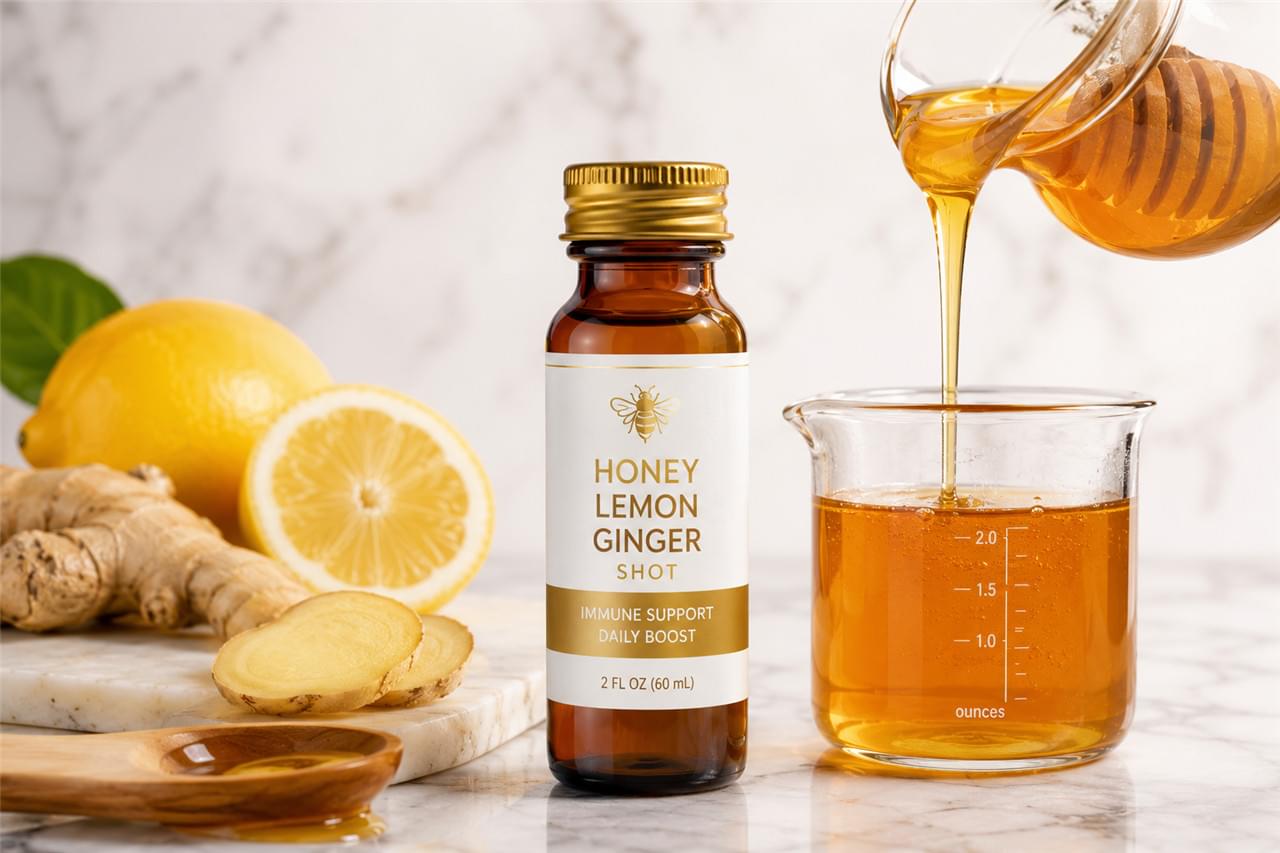
The wellness shot category has exploded in premium grocery and health food retail, and honey-lemon-ginger is its workhorse. The typical build: lemon juice 50–60%, ginger extract or fresh juice 15–20%, honey 20–25%, with optional turmeric, black pepper, or apple cider vinegar. 🍋
These products live or die on pH management for shelf stability. Honey helps twice over — it lowers water activity and contributes mild antimicrobial properties, so the shot holds up better microbiologically than fruit juice alone. For many brands, this is the lowest-risk honey beverage recipe on the menu.
⚡ Honey Energy Drink Manufacturing: The Fastest-Growing Lane
Natural energy drinks carry the strongest growth trajectory in functional beverages, and honey slots in on three axes:
- Carbohydrate profile: Honey’s roughly 40:30 fructose-to-glucose ratio delivers a dual carbohydrate stream — glucose for immediate energy, fructose for sustained oxidation — which matches sports nutrition research on mixed-carb fueling during endurance activity.
- Label claims: “Natural energy from real honey” resonates with consumers in a way caffeine-led energy drinks can’t. Performance or endurance claims, of course, need substantiation under applicable food regulations.
- Formulation compatibility: Honey’s slight acidity complements the typical sports beverage pH of 3.5–4.0 and doesn’t fight with common electrolyte or B-vitamin additions.
That trio is what makes honey energy drink manufacturing attractive: the ingredient does marketing work and formulation work at once. Building a natural energy or snacking line? Our guide on DIY honey energy bars covers the solid-format version of the same positioning.

🫧 Fermented Honey Beverage Recipes: Kombucha and Mead
Beyond the conventional shelf, fermented formats give honey beverage recipes a premium story to tell.
Kombucha: Fermented Honey Beverage Recipes with a Probiotic Edge
Producers increasingly use raw honey as a secondary fermentation sweetener or post-fermentation flavor addition. Honey’s natural compounds complement kombucha’s probiotic positioning and add complexity without synthetic additives. One process-level warning: raw honey introduces wild yeasts that can complicate fermentation management — worth solving before you scale, not after.
Mead: Where Honey Beverage Recipes Decide the Whole Bottle
Once a craft curiosity, mead is now a recognized commercial category across North America and Europe. Honey variety directly shapes the finished character — light acacia builds delicate, floral meads, while dark varietals deliver the bold, complex profiles that barrel-aged products feed on.
📋 Sourcing Specs Beverage Manufacturers Should Demand
Whatever format you pick, consistent raw material is what keeps every batch tasting like the last. For honey procurement in beverage applications, lock down:
- Moisture content: Maximum 20% per the Codex standard; lower is better for concentrate work
- HMF baseline: Well below 40 mg/kg pre-processing, so heat treatment has headroom
- Color and flavor consistency: Specify Pfund color grade — batch-to-batch uniformity is non-negotiable
- Microbial status: Low standard plate count, zero pathogen tolerance
- Filtration: Fine-filtered (no visible particles) for clear beverage applications
Delee Honey supplies honey for commercial beverage manufacturing with full quality documentation and bulk packaging options. For pricing, samples, and detailed specs, reach our export team through deleehoney.com/about-us/ — and browse the full packaging options to match your line’s handling setup. 🐝