


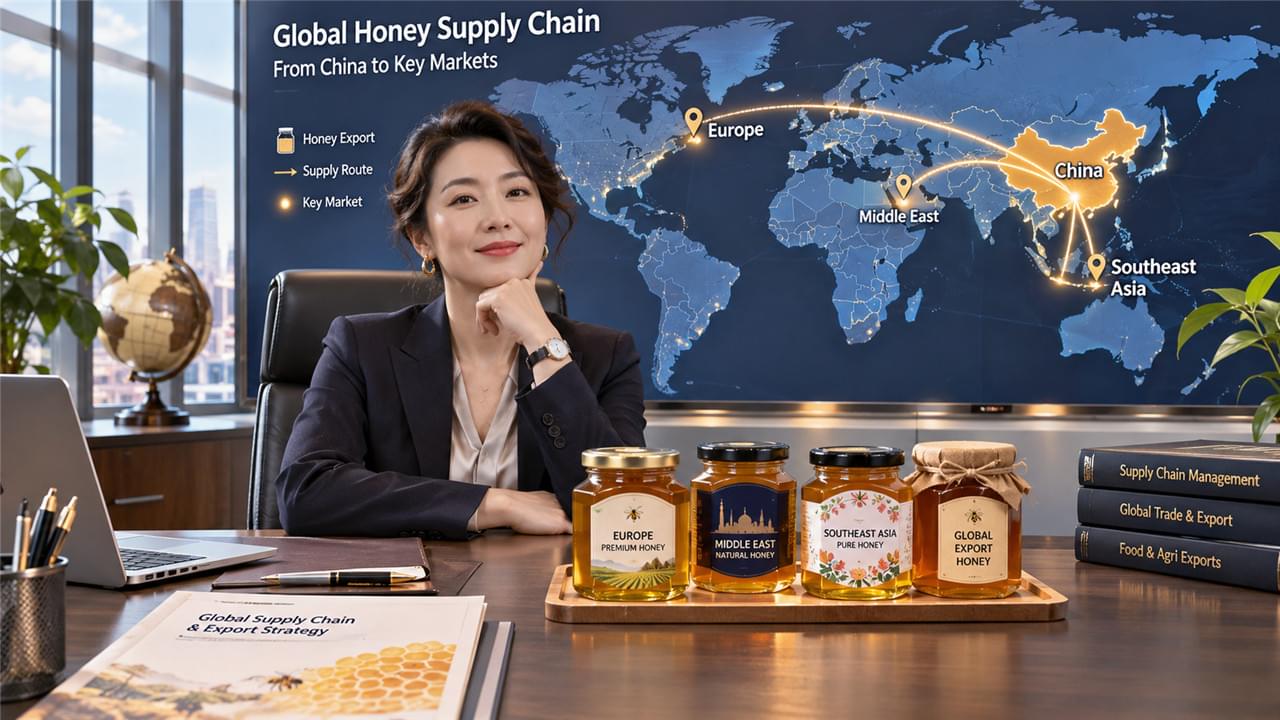
Honey supply chain management looks easy when you serve a single market. Add a second and a third — each with its own paperwork, labeling rules and delivery deadlines — and the habits that worked before stop scaling. 🌍 That is exactly where many importers stall. The three real-world case studies below, drawn from European, Gulf and UK programs, show the structures that keep an international honey supply program under control.
🇪🇺 Scenario 1: One European Importer, Four Retail Markets
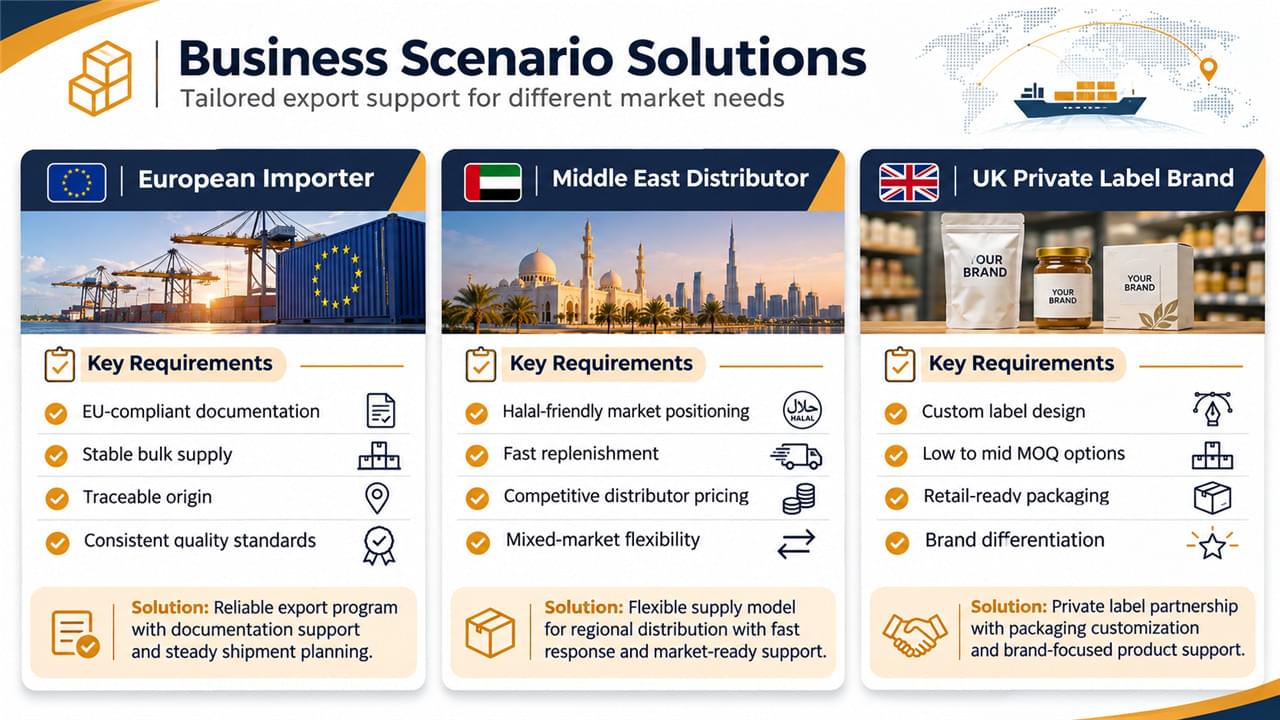
The situation: This importer buys bulk honey from China, warehouses it in Germany, and supplies retail buyers across Germany, France, the Netherlands and Scandinavia. Every retail customer wants something slightly different — label language, organic certification, a specific range of honey varieties.
How Honey Supply Chain Management Works for EU Distribution
The answer is bulk procurement. The importer ships honey in steel drums and IBC containers, then repacks everything domestically at the EU warehouse. One China shipment feeds four markets, because each retail format is produced locally against each customer’s written spec. That single decision removes most of the duplication that makes a multi-market honey export program expensive — and it is the backbone of any workable honey importer supply strategy.
What the Supplier Must Deliver
- Batch-to-batch consistency. Sensory and analytical specifications must hold on every lot, not on most lots.
- A complete documentation package. EU health certificates and lab analysis that align with GFSI-recognized food safety expectations keep border checks routine.
- Flexible lot timing. Shipments need to match European warehouse inventory cycles, not the factory’s convenience.
Delee Honey’s role here is deliberately narrow: supply bulk honey to written specification, document every consignment fully, and coordinate shipment timing with the importer’s planning team. This is honey supply chain management at its most routine — and routine is precisely the goal.
🕌 Scenario 2: A Dubai Distributor Serving the GCC
The situation: A Dubai-based food distributor imports honey for resale across Saudi Arabia, the UAE, Kuwait and other Gulf markets. HALAL certification is non-negotiable, retail labels must carry Arabic, and Saudi Arabia adds its own import registration on top of standard customs paperwork.
Key Honey Supply Chain Management Requirements for the GCC
Gulf programs fail on details, not on price. Four requirements dominate:
- Recognized HALAL certification from a body that GCC import authorities actually accept — not just any certificate 🕌
- Country-of-origin paperwork declaring Chinese origin consistently on every document
- Arabic labeling, either printed in China or applied at a UAE free zone
- Heat protection. Gulf summers push container temperatures to levels that can damage honey quality, so transit monitoring matters 🌡️
How Honey Supply Chain Management Is Managed in Practice
Delee supplies HALAL-certified honey and supports Arabic labeling on the primary packaging. Temperature data loggers ride inside every summer container, and Saudi registration documentation is handled by the distributor’s local regulatory consultant. Each party owns what it does best — and that clean division of labor is what mature honey supply chain management looks like in practice.
🇬🇧 Scenario 3: A UK Private Label Brand on Two Channels
The situation: This brand sells through its own e-commerce store and a premium supermarket chain, with acacia and linden honey as the core range. Repeat customers expect the same jar they bought last season — same color, same flavor, no surprises.
Honey Supply Chain Management for a UK Private Label Brand
Three requirements shape this program:
- Locked varietal character. A written specification for each variety documents color, flavor and analytical parameters, so “same as last time” becomes a measurable standard rather than a verbal promise.
- Label agility. Labels change periodically, and minimum orders per lot are set low enough that a redesign does not strand the brand with outdated inventory.
- Post-Brexit paperwork. UK import rules now differ from EU rules. The documentation side follows the same China honey export process we break down step by step in a separate guide.
✅ Four Honey Supply Chain Management Principles That Travel Well
Different markets, different buyers — yet the three programs above rest on the same honey supply chain management foundations:
Written specification first. Every successful program starts with an agreed, documented specification. Without one, every quality conversation collapses into a matter of opinion, and disputes settle badly.
A fixed communication rhythm. Monthly or quarterly supply reviews catch problems while they are still small. Production capacity, harvest outlook and pricing all belong on that agenda, ideally alongside the honey market trends shaping next year’s costs.
Inventory buffers sized to the harvest. Honey supply is seasonal, and procurement timing relative to the annual harvest cycle affects both price and availability. Experienced buyers plan three to six months ahead of actual requirement rather than ordering against urgent demand.
Suppliers invest in relationships. The attention a factory gives your account depends heavily on how you buy. Committed, multi-year volume earns priority production slots and faster problem-solving; spot transactions simply do not.
🤝 Building Your Own Multi-Market Program
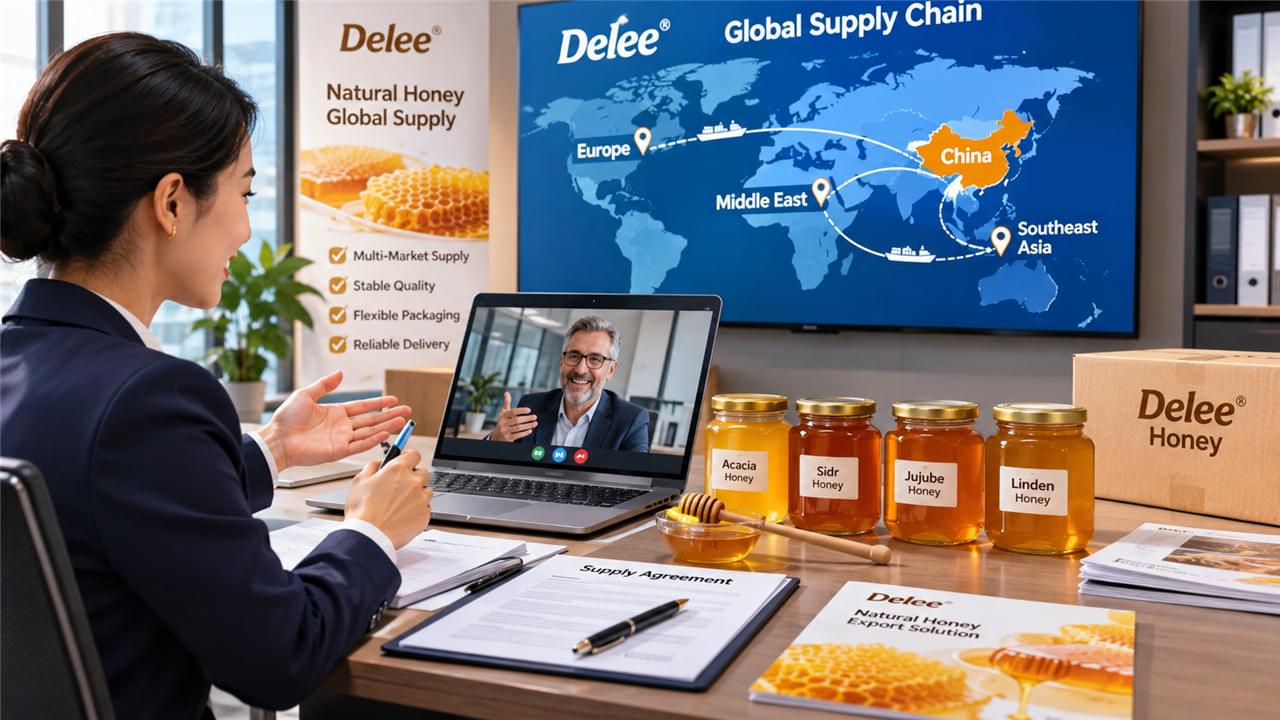
Whether you are a European importer, a Gulf distributor or a private label brand, the pattern holds: written specifications, an honest communication rhythm, and a supplier who has shipped to your region before. Good honey supply chain management is not complicated — it is consistent.
Delee Honey runs multi-market honey export programs across Europe, the GCC, Southeast Asia and North America, and understands the certification, documentation and quality expectations of each market. For the full logistics picture — freight options, Incoterms, warehousing — start with our pillar guide to honey supply chain and logistics. To talk through a program for your specific markets, reach the export team via deleehoney.com/about-us/. 📦