











Navigating health claims in the food and beverage industry requires a delicate balance between marketing appeal and scientific accuracy. Understanding honey health benefits from a rigorous research perspective allows brands to build credible, high-value products without overstepping regulatory boundaries. While consumers have revered honey as a natural superfood for millennia, modern clinical studies now clarify exactly how this amber elixir works at a molecular level.
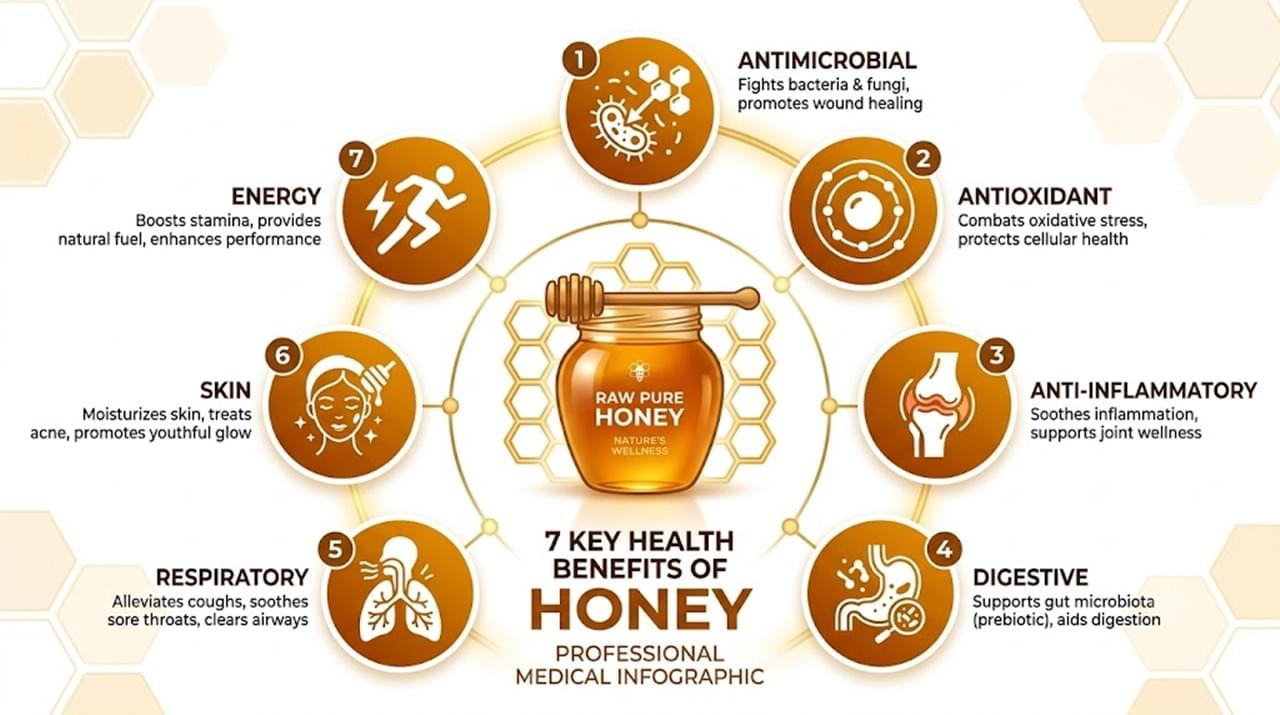
Whether you are formulating functional beverages, wellness snacks, or nutricosmetics, matching the right honey variety to your product goal is critical. Here is a breakdown of seven evidence-based honey health benefits, the strength of their supporting research, and how to leverage them in commercial product development.
🧪 1. Antimicrobial Action: Core Honey Health Benefits
Honey’s ability to combat harmful microbes remains its most thoroughly documented functional property. This potent natural defense relies on four synergistic mechanisms: continuous hydrogen peroxide generation via glucose oxidase, high osmotic pressure from natural sugars, a low acidic pH (3.5–4.5), and protective polyphenols.
In clinical settings, medical-grade varieties like Manuka exhibit exceptional wound-healing performance. For food manufacturers, these natural antimicrobial traits offer a clean-label solution to preserve freshness, inhibit spoilage organisms, and enhance safety documentation for quality-conscious buyers.
🛡️ 2. Antioxidant Power: Unlocking Honey Antioxidant Benefits
Rich in flavonoids and phenolic acids, raw honey acts as a natural scavenger against oxidative stress. Standard DPPH assays consistently confirm these honey antioxidant benefits, though strength varies widely across botanical sources. Darker varieties—such as buckwheat, jujube, and wildflower honey—contain substantially higher antioxidant concentrations than lighter honeys.
When designing functional shots, energy bars, or immunity blends, selecting dark floral honeys delivers measurable antioxidant capacity. Formulators can leverage these bioactive profiles to replace synthetic preservatives while offering authentic, plant-derived cellular protection.
🔥 3. Inflammation Control: Honey Anti-Inflammatory Properties
Laboratory studies demonstrate that specific polyphenols in honey suppress pro-inflammatory pathways, reducing key inflammatory markers like prostaglandins and cytokines. Exploring these honey anti-inflammatory properties and broader honey health benefits opens exciting possibilities for wellness products targeting active lifestyles and systemic recovery.
While human clinical trials continue to expand, regulatory authorities carefully scrutinize explicit anti-inflammatory label claims. Product developers can confidently utilize this underlying biochemistry to support narrative storytelling and scientific product dossiers, ensuring compliant market positioning across global jurisdictions.
🌿 4. Digestive Support: Prebiotic Honey Health Benefits
Beyond simple sweetness, certain honey varieties contain non-digestible oligosaccharides that act as prebiotics. These natural complex sugars nourish beneficial gut bacteria like Bifidobacteria and Lactobacilli, encouraging a balanced microbiome. Furthermore, research indicates honey exerts a soothing, protective effect on gastric mucosa, aiding digestive comfort.
In the booming gut-health market, positioning honey as a dual-purpose functional sweetener allows brands to stand out. It replaces refined sugars while providing documented digestive support that resonates with health-conscious shoppers.
🫁 5. Respiratory Relief: Calming Coughs Naturally
Pediatric clinical trials have repeatedly demonstrated that honey calms nighttime coughs as effectively as over-the-counter dextromethorphan. Its thick, viscous texture coats throat mucosa, easing irritation and promoting restful sleep. In fact, the World Health Organization highlights honey as a safe, accessible recommendation for cough management.
This established efficacy makes honey an ideal cornerstone ingredient for natural cough syrups, soothing throat lozenges, and evening wellness beverages designed for family-friendly relief.
📊 6. Glycemic Management: A Smarter Natural Sweetener
Honey offers a lower glycemic index (GI 45–65) compared to table sugar (GI ~65) and pure glucose (GI 100). Because honey contains a naturally higher fructose-to-glucose ratio, it breaks down more gradually in the liver, blunting sharp blood sugar spikes.
For low-GI formulations, Acacia honey is particularly prized due to its slow-crystallizing nature and mild flavor profile. Incorporating high-fructose honeys allows manufacturers to market cleaner, sustained-energy products without sacrificing taste or texture.
✨ 7. Nutricosmetics & Honey Skin Health
The cosmetic and nutricosmetic industries are tapping into honey skin health like never before. Topical formulations draw on honey’s natural humectant qualities to lock in moisture, while oral beauty-from-within products harness its polyphenol spectrum to protect dermal collagen against oxidative breakdown.
Whether formulated into hydrating face masks or skin-nourishing dietary supplements, honey delivers double-duty performance—combining anti-aging antioxidants with gentle antimicrobial protection as part of holistic honey health benefits.
🍯 Matching Honey Variety to Functional Product Claims
Choosing the right floral origin ensures maximum bioactive impact for your specific formulation targets:
| Benefit Focus | Recommended Honey Variety | Key Scientific Rationale |
| Antioxidant Power | Buckwheat, Jujube, Wildflower | Elevated polyphenol & flavonoid content |
| Gut & Prebiotic Health | Polyfloral, Manuka | Natural oligosaccharides & active enzymes |
| Clean Low-GI Sweetener | Acacia | High fructose ratio, mild taste, slow crystallization |
| Skin & Beauty Nutrition | Wildflower, Polyfloral | Broad-spectrum antioxidant protection |
🚀 Elevate Your Formulations with Technical Support
Bringing functional honey products to market requires verifiable ingredient standards. At Delee Honey, we supply floral-variety-specific honey backed by rigorous laboratory testing—including detailed analysis of polyphenol content, DPPH antioxidant activity, enzyme levels, and standard quality parameters. If you need custom raw material solutions, you can Request technical specification sheets → directly from our team.
To explore broader nutritional science across our entire product range, check out our comprehensive Honey and Bee Products Health Guide. You can also dive into our dedicated Royal Jelly Health Benefits article to discover how other hive ingredients can enrich your product portfolio and help you maximize these honey health benefits in your next product line.