











Ask a bakery formulator about honey in healthy baking and you’ll get a version of the same answer: it’s the rare sweetener that improves the label and the loaf at the same time. Clean-label and reduced-sugar positioning have made reformulation a standing priority across the sector, and honey earns its place not just with consumer appeal but with real functional performance in the finished product. 🍯
This guide covers the practical side of honey in healthy baking — why it works in bakery formulas, the substitution ratios that survive small-batch testing, variety selection, and the scaling details that bite at commercial volume. It’s part of our series on honey culinary applications, and if you’re still comparing sweetener options, our honey vs artificial sweeteners guide is a useful backdrop.
🍞 Why Honey in Healthy Baking Works
Honey’s value in bakery goes beyond label storytelling. It delivers measurable functional benefits across the metrics that matter on the production line.
💧 Moisture Retention: The Honey in Healthy Baking Payoff
Honey’s hygroscopic character attracts and holds ambient moisture, slowing the staling rate in soft-texture products. Sandwich breads, muffins, and soft cookies formulated with honey keep their texture meaningfully longer than sucrose-equivalent recipes — without extra humectants.
🔥 Maillard Browning: A Technical Edge for Honey in Healthy Baking
The free monosaccharides in honey — fructose and glucose — join the Maillard reaction more readily than sucrose, which has to break down first. The result: richer crust color at lower temperatures and shorter bake times. Technically useful, yes, but it means standard recipes need adjusting.
🎨 Flavor Contribution: The Varietal Dimension of Honey in Healthy Baking
Depending on variety, honey adds a floral or caramel-adjacent note that enriches the finished product’s flavor profile. The trick is choosing the right intensity for the application — subtle for delicate cakes, bolder for whole-grain lines.
⏳ Shelf Life Extension: A Quiet Honey in Healthy Baking Bonus
Honey’s low water activity and mild antimicrobial properties contribute to extended microbiological shelf life in certain formats, especially products with higher water activity. It won’t replace a preservative system, but it tilts the numbers in your favor.
🧮 Core Reformulation Ratios
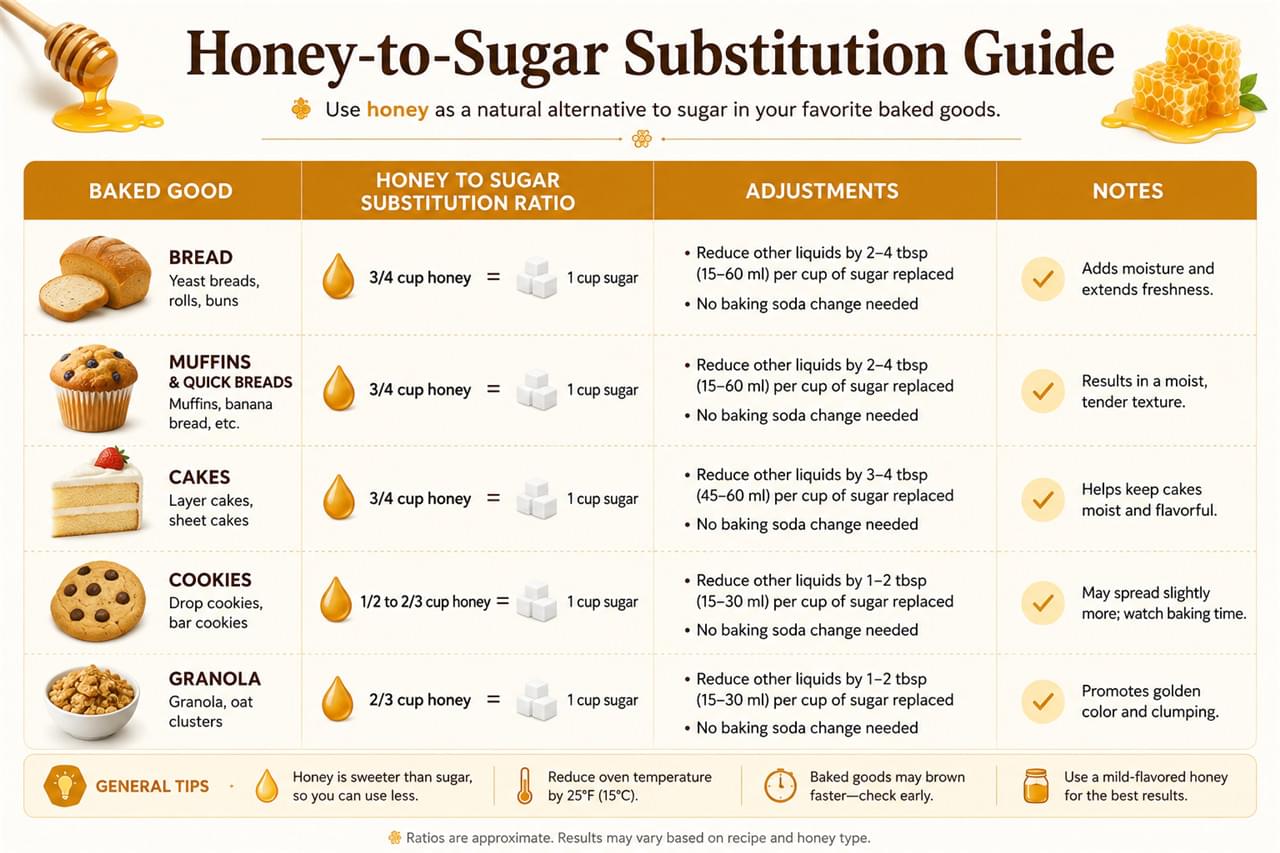
To replace sugar with honey in baking, you adjust two things at once: quantity and liquid content. These are working ratios for initial small-batch testing — scale trials are required before full production changes.
| Baked Good | Sugar → Honey Ratio | Liquid Adjustment | Temperature Adjustment |
|---|---|---|---|
| Bread and rolls | 1:0.75 | Reduce liquids by 20ml per 100g honey | Reduce by 15°F / 8°C |
| Muffins and quick breads | 1:0.75 | Reduce liquids by 15ml per 100g honey | Reduce by 15°F / 8°C |
| Cakes | 1:0.75–0.80 | Reduce liquids by 20ml per 100g honey | Reduce by 15–25°F / 8–14°C |
| Cookies | 1:0.75 | Reduce butter/oil by 10–15% | No change or slight reduction |
| Granola and cereal bars | Direct substitution at 1:1 | No adjustment needed | Monitor browning |
One more chemistry note: honey is slightly acidic (pH 3.9–4.5), which activates baking soda. If your recipe leans on baking soda as the leavening agent, bumping it up slightly improves lift; if baking powder does the work, no adjustment is typically needed. These honey baking formulation tips work best when paired with disciplined small-batch testing.
🌼 Selecting the Right Honey Variety for Baking
Not every honey in healthy baking performs the same — varietal selection shapes both function and flavor.
- Acacia honey: pale color, mild flavor, high fructose content that stays liquid longer and supports soft texture. The first pick for white cakes and delicate muffins where honey should whisper, not shout — see the acacia honey product category for spec details.
- Linden honey: medium amber, moderately floral. At home in bread and pound cake where a distinct but not dominant honey note fits.
- Wildflower honey: medium amber with seasonal flavor variation. The cost-effective workhorse for mass-market lines where formulation manages consistency.
- Dark varietals (buckwheat, chestnut): robust and assertive — built for whole-grain breads, gingerbread, and specialty products where bold is the feature.
🏭 Scaling Considerations for Commercial Bakery
Commercial scale adds three considerations that pilot kitchens never hit.
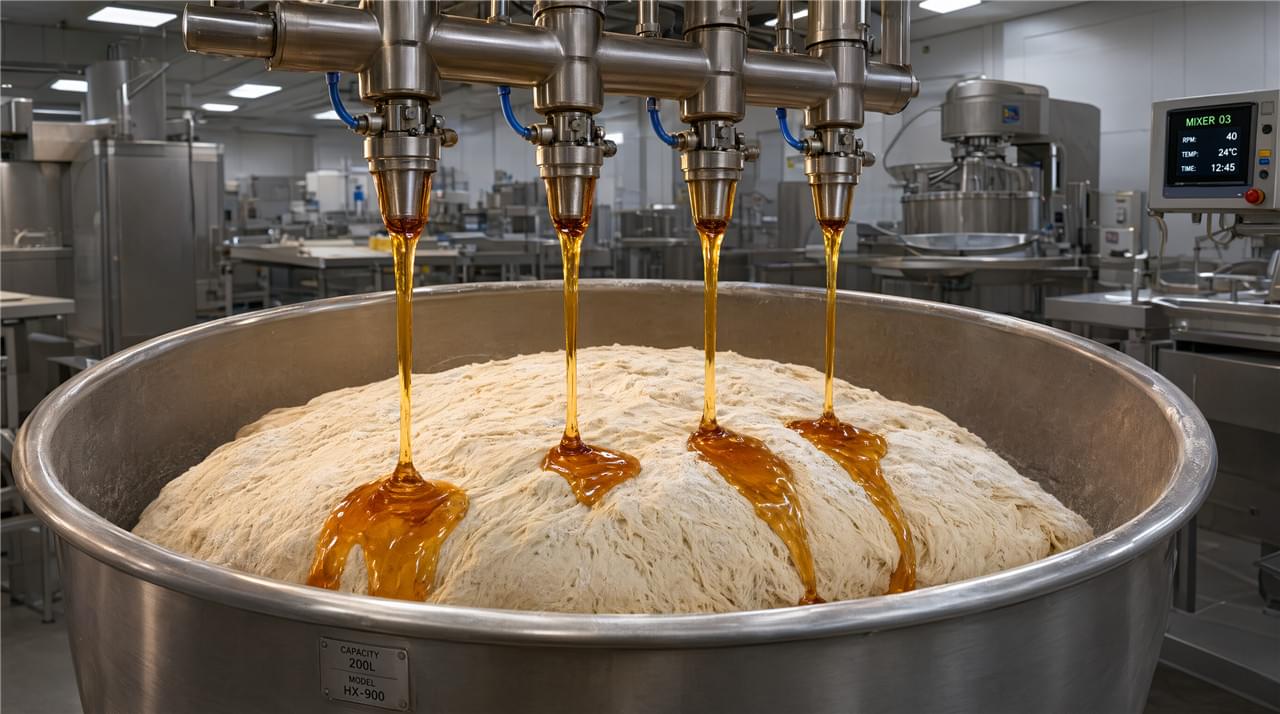
Viscosity and handling: bulk honey needs temperature-controlled handling for accurate dosing. Most facilities heat honey to 35–40°C for pumping and metering — but overheating degrades enzymes and pushes up HMF. The Codex Alimentarius honey standard is the reference point most buyers write specs against.
Supplier consistency: specify moisture content, HMF, diastase activity, and color grade (Pfund or USDA scale) in supplier qualification. Clean label bakery ingredients demand full documentation: country of origin, botanical source, and third-party laboratory analysis — anything that backs a “made with natural honey” or “no refined sugar” claim.
Custom formats: Delee Honey supplies bulk honey for commercial bakery applications with full quality documentation, including 300kg drums for high-volume manufacturing. The packages page shows the full range of formats, and our export team handles pricing and custom specifications. 🐝